
Karma Project Grants
United We Om believes that karma yoga, acts of selfless service without attachment to the outcomes, creates deep, powerful and lasting change on both the individual and the collective levels.
Karma yoga can present itself in many forms and our Karma Projects, our micro-grants program, support and amplify the good works of inspiring humans who are dedicated to creating change in themselves, their community and humanity.
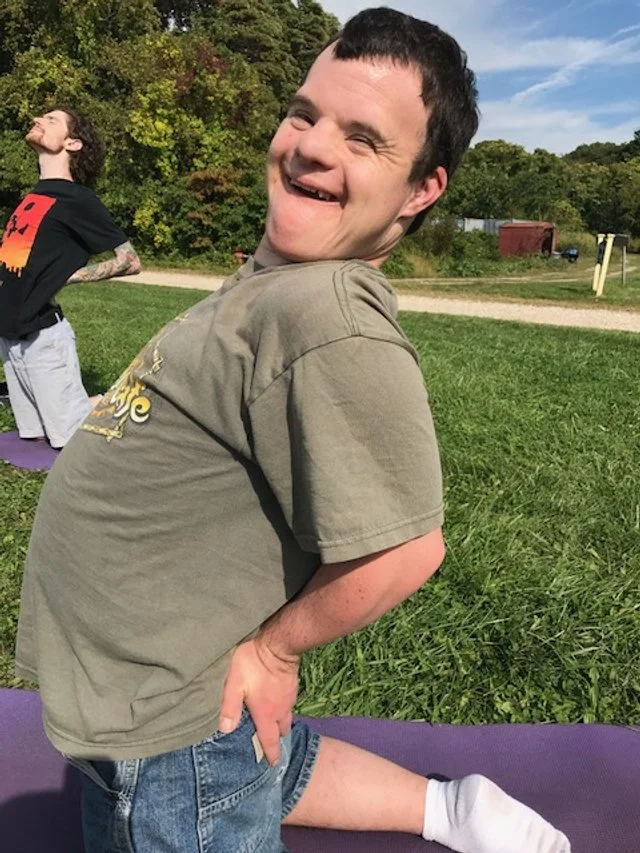
Yoga practitioner at Orkestai Farms, a previous Karma Project.
The Fall 2026 grant application window
is closed.
Grants will be awarded in September.
Karma Project Grant Required Reading
Things to know and tips for success:
Read the entire grant guidelines page. If you apply for a grant and do not follow these guidelines, your grant will not be scored.
How you choose to describe the community you are serving is how United We Om will describe your grant to the public. If you say in your application that you are serving a “low income community” or “members of the LGBTQ+ community”, that is how the grant will be conveyed. Please be careful how you are presenting the community you are serving if they are vulnerable or sensitive to descriptions.
Your budget should be a line-item budget. As an example, if you are applying for support to purchase “$500 of yoga props,” you will need to provide budget specifics, regarding which props you plan to purchase, the cost including tax and shipping, quantity, etc.
If you are planning to host workshops or classes, you need to provide a detailed description of each class, as well as information about the selected instructor’s qualifications.
Do not use AI to write your application. We are interested in meeting you, learning about you and your service work. We are not looking for a perfect application and using AI will negatively impact your grant’s score.
Do not copy and paste from your website. The grant committee will review all of your online offerings.
What types of projects are you looking to fund?
We seek to fund individuals and small nonprofits who are creating great change in their communities, using their own life experiences to serve other people dealing with similar struggles.
We seek to fund individuals and small nonprofits in which $2500 will significantly benefit their service work and represents 1% or more of their annual budget. Essentially, nonprofits with annual budgets of $250,000 or less.
We seek to fund individuals and small nonprofits who perform their service work without financial compensation. While we do allow people to compensate themselves for their service work, preference is given to people who are performing their service work without compensation.
We fund fully formed ideas and projects with specific goals and intended outcomes.
We fund expansions of currently existing programs, innovative pilot programs and projects providing necessary resources to people without access.
We look for projects and programs that can be sustained beyond the grant period without additional funding from United We Om.
What types of projects do you NOT fund?Projects that are not Karma Yoga. There are many wonderful ideas, serving many worthy people, but they are not all Karma Yoga. As a Karma Yoga nonprofit, this is our main focus.
Projects that provide wellness services to communities with traditional access available.
Projects with inflated budgets. Examples include stipends for instructors that are beyond our $50 per hour rate, excessive snack budgets, or superfluous items not related to the grant’s execution. If your project’s budget is $1800, please don’t add additional expenditures to reach the $2500 maximum.
Budgets which reflect compensation that is higher than market rate.
Art projects, films, musical or theatre performances and similar public exhibitions of artistic performance that do not directly serve an underserved community. Having members of an underrepresented community involved with the art project does not qualify as serving an underserved community.
Organizations with annual budgets over $250,000.
Organizations that require membership or will require participants to pay to continue with the program after the grant funding has ended.
The general service work of your organization. As an example, if you giveaway free diapers to low income mothers, we would not approve a grant to cover $2500 of diapers. However, if you applied with an idea to make the free diapers available to a specific underserved community, or to make the offering sustainable by switching to cloth diapers, that is something we would consider supporting.
Partially funded projects. If your project budget exceeds $2500, we will only consider your project if the additional funding is already in place and a $2500 grant will allow the project to go forward. Proof of existing funds will be required.
Individuals and nonprofits residing outside of the United States of America, or individuals and nonprofits performing their service work outside of the United States of America.
For-profit businesses or projects that could enhance a for-profit business or their reputation. An example could be, a for-profit yoga studio offers a paid training and would like to use the grant funding to “give away a spot” in the training to someone from an underserved community.
Projects that are are offered by people who are not from the community they are applying to serve. As an example, a project serving Veterans’ mental health would need to be conducted by a Veteran. A project for the LGBTQ+ community, would need to be led by a member of that community.
Projects that have a for-profit version, which you would like to offer at no-cost to an underserved community with the grant funding.
Projects that have a participation fee of any kind, including by-donation events. Your offering must be a “total give” to the participants.
Projects that are religious in nature, espouse a specific religion’s belief system or require participation in a religious activity, including mantra and prayer. If you are a religious organization offering service work, we often work with organizations associated with specific religions, however the service work must be entirely separate from all religious dogma.
Projects that offer any form of therapy, medicine or medical advice, including herbal or plant medicines, unless you are actively licensed by a recognized medical authority.
One day events. We look for projects with a trajectory and momentum.
Projects that will occur outside of the 6 month grant window, unless the project is on-going.
Any form of political or societal activism. As an example, if you are serving the houseless community, you can provide information about resources available to them, but you cannot encourage them to vote for a specific candidate or use the funding for any form of protest.
We do not fund projects that are in the development stages.
We do not fund projects without a clearly defined timeline, budget, personal and intended outcomes.
Things we do NOT allow our grant funding to be used for:
Staff salaries or any form of compensation not directly related to the execution of the grant.
Travel time, travel stipends, transportation or accommodations.
Grant preparation or the completion of grant requirements, data processing or any form of administrative work.
Legal or accounting services.
Volunteer stipends.
Tuition reduction or participation fee supplementation.
Software, website or tech updates.
Participation giveaways or attendance incentives.
Additional Information and FAQ
How much funding may I request?Our micro-grants range from $500 to $2500. You will be asked to present a detailed line-item budget of how you intend to spend the funding.
What is the timeline for the application process?There are two grant opportunities offered annually.
The 1st application window opens on November 1st.
The 1st application window closes on December 31st at midnight.
The applications will be reviewed by committee throughout January and February.
Finalists will be contacted in March for any additional or supplementary information.
Grants will be awarded in April.
The 2nd application window opens on May 1st.
The 2nd application window closes on June 30th at midnight.
The applications will be reviewed by committee throughout July and August.
Finalists will be contacted in August for any additional or supplementary information.
Grants will be awarded in September.
How long do I have to complete the grant?Grants are required to be completed within six months of receiving funding.
How will United We Om determine if a project is successful?Grantees will be required to provide metrics of success, as defined by United We Om, in the form of monthly check-ins, as well as Narrative, Data and Financial Progress Reports at the mid-point and at the conclusion of the Karma Project.
Can I be paid for my work?Yes, we allow grantees to be paid up to $50 per hour for your “service time,” which is defined as actively presenting information and/or completing your act of service (ex: leading yoga class, serving food to someone, etc). While we understand that the market rate for some services may be more than $50 per hour, compensation for your service work is not meant to assign a financial value to your work or to be competitive, but is an acknowledgment that we live in a modern society that sometimes requires monetary exchange for an offering to be possible. If the market rate is less than $50 per hour for your service, your budget should reflect a rate that is inline with your industry standard in your location.
What are some examples of projects you have supported in the past?Please see our 2026 Karma Projects for our most recent examples.
How are grants selected?Grants are selected by a committee of at least five individuals, who utilize a rubric of criteria, to assign a numerical score to each grant. At least two committee members will read every grant. Finalists will be the top scores selected by the committee and all finalists will be read and scored by the entire grant committee.
What kind of support or assistance will United We Om provide? What is the responsibility of the grantee?United We Om will provide all grantees with a representative to help ensure a successful project, however, grantees will have the sole responsibility for the planning, management and implementation of their own Karma Project. Grantees will be responsible for collecting data about their project, maintaining their own books and records in a manner that will provide United We Om and/or the Internal Revenue Service, with sufficient detail to review your receipts and expenditures relating to the Grant.
How long will the application take to complete?The process is different for each applicant and each project. Applicants with a well formulated idea and a pre-existing budget, on average will take less than one hour to complete the application.
Where can I review the application questions before I apply?You can download the Application for Nonprofits or the Application for Individuals for your review. These are NOT the actual application. When the application window is open you will find blue buttons below, linked to the applications.
Have another question?Please email our Executive Director, Matt Jared at matt@unitedweom.org.
Got a great idea for a service project?Applications will open again in November.